
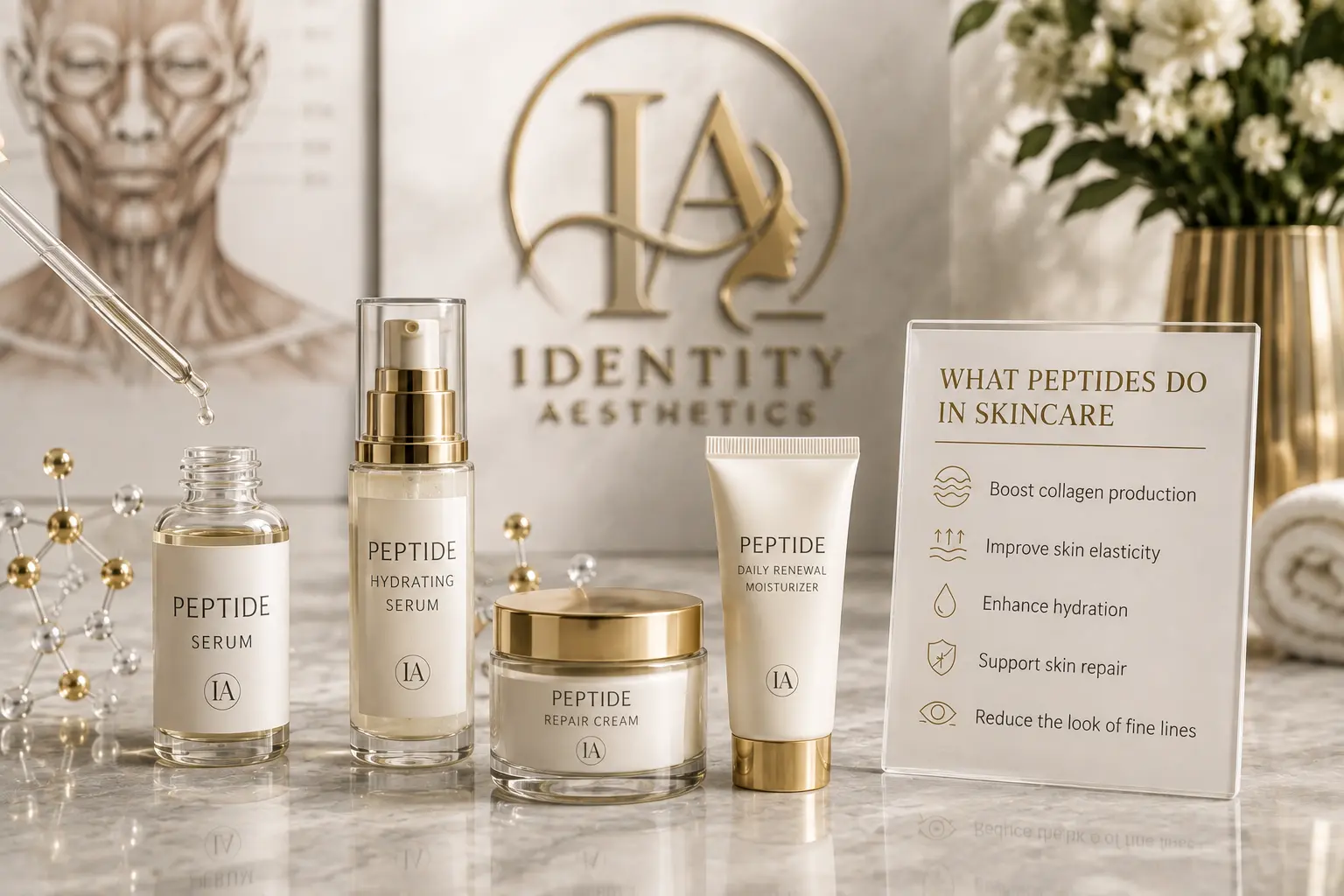
Peptides are short chains of amino acids. In topical skincare, certain peptides are designed to act as signals, carriers or enzyme modulators. Depending on the peptide and formula, they may support improvements in the appearance of fine lines, texture, hydration and firmness.
If your bathroom cabinet is full but your skin still feels dull, dry, uneven or less firm, you are not alone. The skincare market makes it easy to buy more. It does not always make it easy to buy well.
Peptides have become one of the most talked-about ingredients in professional skincare because they offer a thoughtful approach to visible skin aging: supporting the signals and structures that help skin look smoother, firmer and healthier. But “contains peptides” is not proof that a product will work. The specific peptide, concentration, formula stability, delivery system and the rest of your routine all matter.
That is where physician-guided skincare earns its value. The goal is not to sell you the longest routine. It is to identify what your skin needs, choose products with a defensible scientific rationale and build a plan you can use consistently.
How topical peptides are intended to work
“Peptide” describes a large family of molecules, not one ingredient with one guaranteed result. A 2026 systematic review and meta-analysis of 19 randomized trials found modest benefits across several skin-aging measures, but 17 of the 19 trials studied oral products and only two studied topical formulations. The researchers also reported substantial differences among products, doses and outcome measures. One product’s results cannot automatically be applied to every peptide serum on the shelf.
Different peptides are formulated for different jobs
- Signal peptides are designed to mimic fragments involved in the skin’s natural communication processes. Some are studied for their ability to support extracellular-matrix proteins associated with visible firmness and smoothness.
- Carrier peptides bind and deliver trace elements, such as copper, that participate in normal enzymatic processes. Evidence depends on the exact peptide and formulation.
- Enzyme-modulating peptides are intended to influence enzymes involved in the breakdown of structural skin components.
- Neurotransmitter-inhibiting peptides are marketed to soften the appearance of expression lines, but their effects and skin penetration are formulation-dependent and should not be compared with injectable neuromodulators.
Skin is designed to keep substances out, so delivery is a real challenge. Peptide size, chemical properties, vehicle, stability and contact with the skin influence whether a formula can produce a meaningful result. Reviews of cosmetic peptides have specifically noted that penetration through the outer skin barrier can be limited. That is why reading “peptides” on the front of a bottle tells you very little by itself.
Why we highlight SkinMedica TNS Advanced+ Serum
For patients whose goals include visible firmness, smoother texture and improvement in fine and coarse lines, SkinMedica TNS Advanced+ Serum is a standout professional option available at Identity Aesthetics.
More than a basic peptide serum: its dual-chamber system combines TNS-MR, SkinMedica’s next-generation growth-factor blend, with RENESSENSCE (RSC) Advanced, a blend of botanicals, marine extracts and peptides designed to complement the growth-factor formula.
In a randomized, vehicle-controlled 24-week study of a growth-factor serum corresponding to TNS Advanced+, clinical assessments favored the active serum for several visible signs of facial photodamage, including sagging and fine and coarse lines. The study also included laboratory and biopsy measures.
This is meaningful product-specific evidence, but transparency matters: several study authors were affiliated with Allergan Aesthetics, an AbbVie company, and the evidence should be understood as industry-sponsored rather than independent replication.
SkinMedica describes TNS Advanced+ as a twice-daily cosmetic product and reports that visible changes can begin within two weeks and continue over 24 weeks in its clinical study. Individual results vary. Cosmetics are not drugs intended to diagnose, treat, cure or prevent disease.
Who may be a good fit?
TNS Advanced+ may be considered for an adult who is noticing fine lines, deeper wrinkles, uneven texture or loss of visible firmness; wants a noninvasive at-home product backed by product-specific research; will use it consistently for several months; and wants it integrated with sunscreen, moisturizer and other appropriate actives instead of added at random.
It may not be the best first investment for every person. Active irritation, uncontrolled acne, rosacea, eczema, allergies, pregnancy-related restrictions, medication use, budget and the rest of your regimen can change the recommendation. A skin consultation helps answer the most useful question: Is this the right product for your skin right now?
Are physician-only peptide products really superior?
Here is the honest answer: “Medical-grade” or “physician-dispensed” is not, by itself, an FDA-defined guarantee that a cosmetic is stronger or more effective. A professional product should earn your trust through its formula, manufacturing, product-specific testing, appropriate packaging and responsible guidance - not through a label alone.
The advantage of purchasing professional peptide skincare through a qualified medical practice is the system around the product:
- A real skin assessment. Dryness, acne, rosacea, pigment changes, sun damage and irritation can look similar but require different plans.
- A formula selected for your goal. We look beyond the word peptide to the complete ingredient system and available evidence.
- Correct sequencing. Even an excellent serum can disappoint when layered incorrectly, combined with too many irritating actives or used inconsistently.
- Authentic sourcing and proper handling. You receive the intended product from a traceable source, with guidance on storage and use.
- Follow-up and adjustment. If your skin becomes irritated or your goals change, the plan can change with it.
This is why physician guidance can make a professional skincare investment more valuable: the right formula is matched to the right person and used as part of a complete plan.
What a customized physician-guided peptide plan can - and cannot - do
A personalized peptide strategy for skin health should begin with topical skincare, not a promise of a “fountain of youth.” A responsible plan can include:
- A baseline evaluation. We review your concerns, current products, medications, sensitivities, health history, sun exposure and previous treatments.
- A focused home regimen. A peptide or growth-factor product may be paired with daily broad-spectrum sunscreen, an appropriate moisturizer and - when suitable - a retinoid, antioxidant or pigment-focused product.
- A tolerability plan. We set the order, amount and frequency so your skin has time to adjust instead of becoming inflamed from too many active ingredients.
- Coordination with in-office treatment. When appropriate, the home routine can be timed around procedures so products support - rather than complicate - recovery and maintenance.
- Measured follow-up. Standardized photographs and a scheduled reassessment help separate real progress from day-to-day changes in lighting, hydration or inflammation.
The foundation still matters. Dermatology guidance identifies sunscreen and moisturizer as essential starting points, and the medical literature continues to support photoprotection and topical retinoids as core components of photoaging care. Peptides are an adjunct, not a replacement for sun protection or evidence-based treatment.
A necessary distinction about injectable or compounded peptides
Topical cosmetic peptides are not the same as injectable “peptide therapy.” There is not sufficient high-quality evidence to promise that compounded or research peptides will improve skin quality, reverse aging or outperform a well-designed topical regimen. Compounded drugs are not FDA-approved, and the FDA does not verify their safety, effectiveness or quality before marketing.
If a systemic medication or supplement is being considered, it requires a separate medical evaluation, an evidence-based indication and a clear discussion of alternatives, risks and uncertainty. We do not recommend buying injectable peptides online or using products labeled “research use only.”
What results should you expect from peptide skincare?
Peptide skincare is a consistency treatment, not an overnight transformation. Hydration and surface smoothness may be noticed earlier, while visible changes in fine lines, texture and firmness generally require sustained use. Product-specific study timelines are more useful than generic promises, and no topical can reproduce the lifting or muscle-relaxing effects of an in-office procedure.
A sensible way to judge progress is to use the same routine as directed, take baseline photographs in consistent lighting and reassess after a defined interval. If there is no meaningful improvement, a physician can determine whether the issue is product selection, inconsistent use, irritation, an untreated skin condition or a goal that requires a different modality.
The bottom line
Peptides can be valuable ingredients for skin that looks smoother, more hydrated and more resilient - but the ingredient category is not enough. The exact molecule, complete formula, delivery system, clinical evidence and the rest of your routine determine whether a peptide product is a smart investment.
SkinMedica TNS Advanced+ stands out because it combines peptides with established growth-factor technology and has product-specific published clinical data. Our role is to determine whether it fits your skin, show you exactly how to use it and build the rest of your plan around your goals and tolerance.
Ready to stop guessing? Book an in-office Skin Health Consultation at Identity Aesthetics. Bring your current products - or even a photo of your bathroom shelf. We will help you understand what to keep, what to pause and whether SkinMedica TNS Advanced+ or another physician-guided regimen makes sense for you.
Frequently asked questions
Do peptides build collagen in the skin?
Are peptides better than retinol?
Can I use SkinMedica TNS Advanced+ with retinol?
Are peptide serums safe for sensitive skin?
How long does peptide skincare take to work?
Is injectable peptide therapy better for skin than a topical serum?
Clinical and esthetic review
Reviewed by Dallas Alvey, MD, DDS; Ike Nwanonyiri, MD; and Astrid Ariano, Licensed Esthetician. The reviewers evaluated this article for medical accuracy, skincare context, evidence context and patient-safety language. Learn more about Dallas Alvey, Ike Nwanonyiri and Astrid Ariano.
Medical disclaimer: This article is for educational purposes and is not medical advice. Cosmetic results vary. An in-person evaluation is required to diagnose a skin condition or determine whether a product, prescription, supplement or procedure is appropriate for you. Most SkinMedica products are cosmetics and are not intended to diagnose, treat, cure or prevent disease.
Sources
- Nukaly HY, et al. Oral and topical peptides for skin aging: systematic review and meta-analysis of randomized controlled trials. Frontiers in Medicine. 2026.
- Naughton GK, et al. Targeting Multiple Hallmarks of Skin Aging: Preclinical and Clinical Efficacy of a Novel Growth Factor-Based Skin Care Serum. Dermatology and Therapy. 2023;13:169-186.
- SkinMedica: The Growth Factor Authority.
- American Academy of Dermatology: How to select anti-aging skin care products.
- Emer JJ, et al. Photoaging and Topical Rejuvenation. Facial Plastic Surgery Clinics of North America. 2022.
- U.S. Food and Drug Administration: Understanding the Risks of Compounded Drugs. Updated 2026.