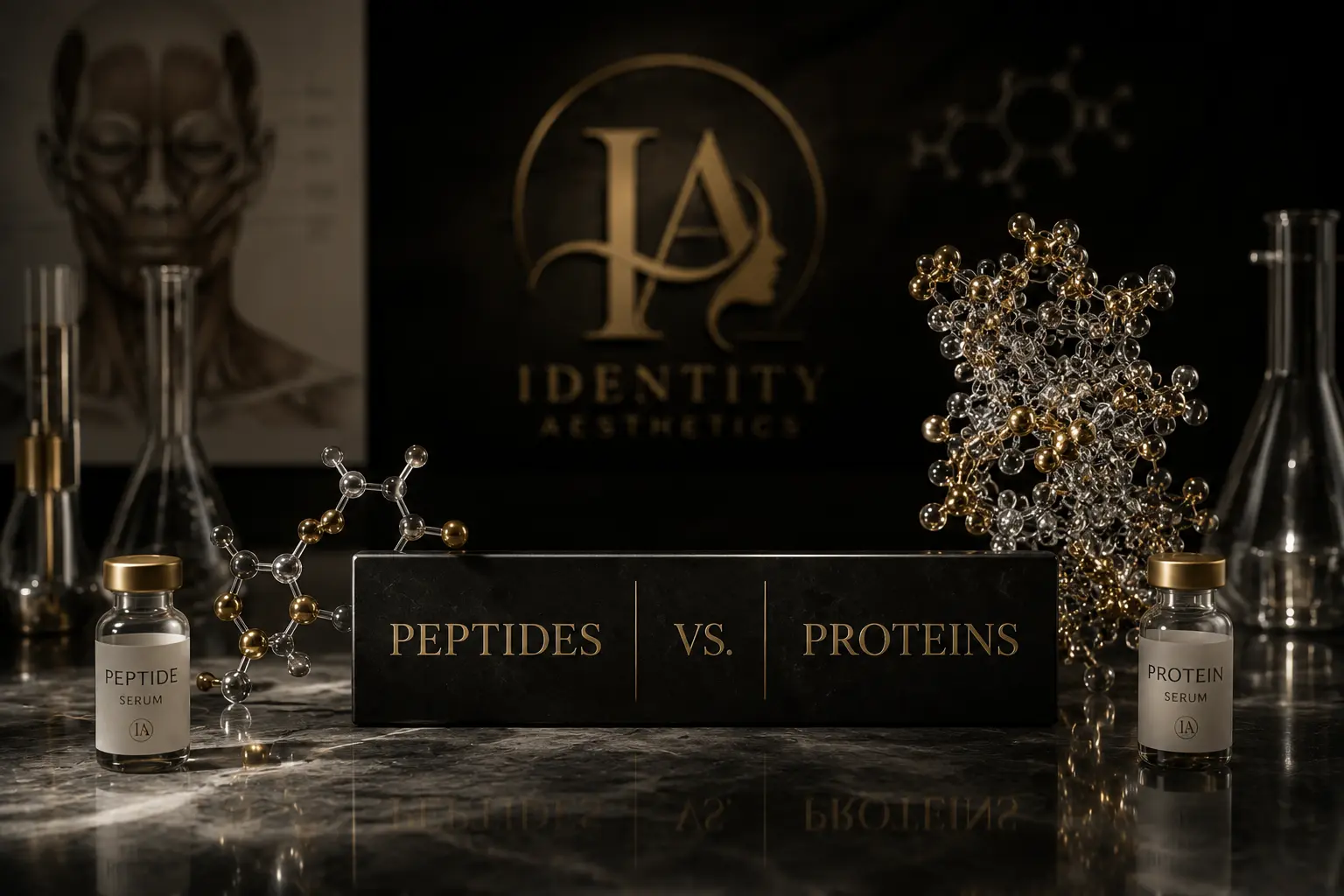
Peptides and proteins are both made from amino acids. Peptides are generally shorter chains. Proteins are longer chains that fold into specific shapes so they can perform jobs in the body. In skincare, the exact ingredient and the finished formula matter far more than whether the front of the bottle says “peptide” or “protein.”
Think of amino acids as letters. A short string of letters can form a message; a much longer, carefully arranged string can become an instruction manual. Peptides are closer to short messages. Proteins are larger, folded structures that can act as the skin’s framework, tools and messengers.
That sounds simple—until marketing enters the conversation. A serum may say “collagen,” “peptides” or “protein complex” in large type without telling you whether the ingredient is intact, broken into smaller fragments, stable in the bottle or supported by research on the finished product. Understanding the basic difference helps you shop with clearer expectations.
Start with the building blocks: amino acids
Amino acids join through chemical links called peptide bonds. According to the International Union of Pure and Applied Chemistry, peptides are compounds made of amino-acid residues linked in this way. Proteins are naturally occurring polypeptides with molecular weights above about 10,000; the practical dividing line is not absolute.
In everyday language, the most useful distinction is:
- Peptide: a relatively short amino-acid chain that may act as a signal, carrier or other functional fragment.
- Protein: a longer chain—or group of chains—folded into a three-dimensional structure that performs a biological job.
Your skin naturally contains important proteins. Collagen provides tensile support, elastin contributes recoil and keratin helps form the protective outer layer. Smaller peptides may be created when proteins are made or broken down, and some are used by cells as signals.
Peptides and proteins at a glance
| Feature | Peptides | Proteins |
|---|---|---|
| What they are | Shorter chains of amino acids | Longer amino-acid chains folded into functional shapes |
| Simple analogy | A text message | A complete instruction manual or working machine |
| Skin examples | Signal peptides and copper-binding peptides used in some formulas | Collagen, elastin and keratin naturally present in or associated with skin |
| On a label | The exact peptide and finished formulation determine relevance | “Hydrolyzed” usually means the protein was broken into smaller fragments |
| What the term proves | Only the ingredient category—not penetration or results | Only the ingredient category—not replacement of the skin’s own proteins |
Why the difference matters in skincare
1. Size affects delivery
The outer layer of skin is an effective barrier. Classic skin-delivery research notes that molecules above roughly 500 daltons generally have difficulty crossing intact skin. This is a rule of thumb, not a promise that every smaller molecule penetrates or every larger one cannot. Charge, oil-and-water balance, vehicle, skin condition and application all matter.
Because intact proteins are usually large, putting collagen protein on the skin does not mean it travels into the dermis and becomes your own collagen. A collagen-containing cosmetic may still help the surface feel smoother or more hydrated, depending on the formula, but that is different from rebuilding the deeper collagen network.
2. “Hydrolyzed” changes the meaning
When a label says hydrolyzed collagen, hydrolyzed keratin or protein hydrolysate, the original protein has been broken into smaller pieces. Those pieces can include peptides and amino acids. Hydrolysis may change solubility and how an ingredient behaves on the surface, but it does not automatically prove meaningful penetration or a clinical result.
3. The exact molecule matters
“Peptide” is a family name, not one active ingredient. Different peptide sequences have different properties. Evidence for one peptide—or one complete serum—cannot be transferred to every product that uses the word.
Smart-label rule: a scientific-sounding ingredient is a starting point for questions, not proof of performance. Look for the exact ingredient, the complete formula, realistic claims and research that matches the product and outcome being advertised.
What does the research actually show?
Some topical peptide formulas have produced measurable cosmetic improvements, but results are formula-specific. In a randomized, double-blind, placebo-controlled study of 93 women with photoaged skin, a moisturizer containing a palmitoyl pentapeptide was used for 12 weeks. Compared with the placebo moisturizer, the peptide formula produced statistically significant improvements in several clinical measures of fine lines and wrinkles. The study was supported by the ingredient manufacturer, so it is useful evidence—not a universal verdict on all peptide products.
The responsible takeaway is narrow: a well-formulated product containing a specific peptide may improve the appearance of photoaged skin over time. It does not prove that every peptide works, that peptides outperform established options such as sunscreen or prescription retinoids, or that a peptide serum can reproduce the effects of an in-office procedure.
Proteins in cosmetics can also be useful as conditioning or film-forming ingredients. But a cosmetic label that says “collagen” does not establish that the product replaces lost collagen in living skin. Under U.S. law, claims that a product treats disease or changes the body’s structure or function can cause it to be regulated as a drug, not simply a cosmetic.
How a professional consultation can save money—and protect your skin
Modern skincare shopping often feels like a second job. Social feeds reward dramatic claims, while your skin pays the price for stacking too many actives. A focused in-office consultation can turn a crowded shelf into a plan:
- Identify the real concern. Dryness, irritation, acne, pigment and sun damage can overlap but need different approaches.
- Review what you already own. Bring your products—or photos of their labels—so we can find duplication, conflicts and useful keepers.
- Prioritize the foundation. Daily broad-spectrum sunscreen, an appropriate moisturizer and a tolerable cleanser usually matter more than chasing the newest trend.
- Match evidence to the goal. We assess the exact formula, not just the hero word on the package, and discuss what results are realistic.
- Set a timeline and follow-up. Introducing products one at a time and reassessing in consistent lighting makes it easier to see what helps.
Professional or physician-dispensed skincare is not automatically superior because of where it is sold. Its value should come from authentic sourcing, thoughtful formulation, product-specific evidence and expert guidance that fits your skin, health history, tolerance and budget.
Five questions to ask before buying
- What is the exact peptide or protein derivative? “Peptide blend” alone is not very informative.
- Is the claim about surface hydration, visible wrinkles or a medical change? Those are not the same outcome.
- Was the finished formula studied? Ingredient research does not always predict how the product performs.
- Who funded the study, how many people participated and how long was it used? Context helps you judge confidence.
- Does this fit my current routine? A good product can still be a poor choice when it duplicates another active or worsens irritation.
Bring us the products you are using—and the results you want. During an in-office Skin Health Consultation, we can simplify your routine, evaluate ingredient claims and build a realistic plan around your skin rather than the latest trend.
Frequently asked questions
Are peptides proteins?
Is collagen a peptide or a protein?
Can a protein in skincare penetrate the skin?
Does a peptide serum automatically build collagen?
The bottom line
Peptides are shorter amino-acid chains; proteins are longer, folded structures. That difference helps explain why a collagen cream, a hydrolyzed-protein moisturizer and a targeted peptide serum are not interchangeable. The most trustworthy choice is not the product with the most scientific words—it is the one with a clear purpose, credible evidence, realistic claims and a place in a routine you can actually follow.
Evidence note: Cosmetic-ingredient research varies in quality, and a study of one molecule or product should not be generalized to every formula in the category. We favor product-specific evidence and disclose important limitations when interpreting results.
Medical disclaimer: This article is for general education and is not medical advice. It does not diagnose or treat a skin condition. Individual needs, reactions and results vary; seek evaluation from a qualified clinician for persistent, changing or concerning skin symptoms.
Sources
- International Union of Pure and Applied Chemistry. Peptides. IUPAC Gold Book.
- International Union of Pure and Applied Chemistry. Proteins. IUPAC Gold Book.
- Bos JD, Meinardi MMHM. The 500 Dalton rule for the skin penetration of chemical compounds and drugs. Experimental Dermatology. 2000;9(3):165-169.
- Robinson LR, et al. Topical palmitoyl pentapeptide provides improvement in photoaged human facial skin. International Journal of Cosmetic Science. 2005;27(3):155-160.
- Mohammed D, et al. Influence of skin penetration enhancers on skin barrier function and skin protease activity. PLOS ONE. 2014;9(7):e101956.
- U.S. Food and Drug Administration. Cosmetics Labeling Claims and FDA Authority Over Cosmetics.